
Do The Thing
On habits, action, and why Epictetus said what you already know.
On habits, action, and why Epictetus said what you already know.
Epictetus wrote in the Discourses that every habit and every faculty is confirmed and strengthened by the corresponding actions. The faculty of walking by walking. The faculty of running by running. If you wish to be a good reader, read. If you wish to be a good writer, write. And if you give up reading for thirty days and do something else, you will know what happens. He said that two thousand years ago and it is still the truest thing I have read about making change. You do not become the thing by thinking about the thing. You become it by doing it.
— Epictetus, Discourses, 2.18
He also warned that if you procrastinate this training, in due course you won’t even be aware that you’re acting wrongly, and will begin to put forward arguments to justify your behavior. At which point you’ll be confirming the truth of Hesiod’s saying that one who delays his work is always wrestling with ruin. That is the part that gets me. Not the delay itself but the justification that grows around the delay like vines on a blueberry bush. You stop doing the thing. Then you explain to yourself why you stopped. Then the explanation becomes the truth and you forget you were ever doing the thing at all.
I know this because I have lived it. I have gone weeks without throwing pots and told myself it was because the studio needed cleaning first. Or because the kiln wasn’t ready. Or because the factory took everything and there was nothing left. Some of those reasons were real. Most of them were Resistance wearing a reasonable outfit. The studio was dirty, yes. But I could have thrown one pot in a dirty studio and been one pot closer to the work I said I wanted to do. The habit of making pots is confirmed and strengthened by making pots. The habit of not making pots is confirmed and strengthened by not making them. Both habits are being practiced at all times. The only question is which one.
Change does not announce itself. It does not arrive in a moment of inspiration or a flash of motivation. It arrives in the repeated action, the one you do today and again tomorrow and again the day after that. I paid off the credit cards by making one payment at a time. I am building the solar system by buying one component at a time. The wood kiln is going up one brick at a time. None of those things happened because I had a breakthrough. They happened because I kept doing the small corresponding action until the thing was done or close enough to see the end of it.
If you want to make change, make the change. Not the plan for the change. Not the research about the change. Not the conversation about why the change hasn’t happened yet. The actual step. One brick. One pot. One page. One payment. Epictetus did not say think about walking. He said walk. The faculty of walking is confirmed by walking. Everything else is just standing still and explaining why. I need to go widen the firebox on the rocket kiln. That is today’s corresponding action. Tomorrow’s will be whatever tomorrow asks for.
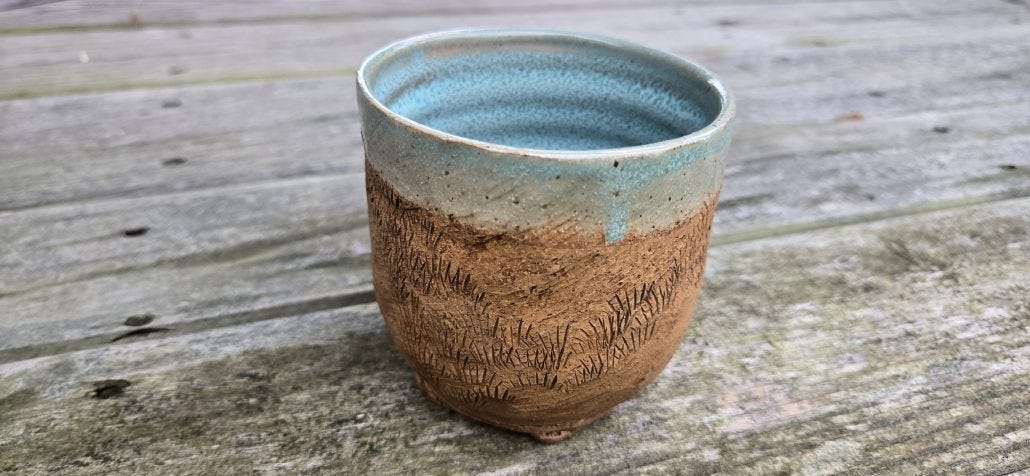
If I were living yesterday a second time: I would have spent less time reading about change and more time doing the thing that is the change.
Things I am grateful for: The faculty of making pots, which is still in my hands if I use them.
If I get to live to be 86, I might only have: 12,651 days left.
Originally published at Creek Road Pottery
Connect with Creek Road Pottery LLC:
Website | Shop | Collectors Club | The Pin Tool Podcast | Instagram | Bluesky