
Your First Pots
On lumpy beginnings, forgiving clay, and why bad pots are the whole point.
Everybody’s first pots are terrible. That is not an insult. That is the most encouraging thing I can tell you. The first time you sit down at a wheel the clay has no idea who you are and no interest in cooperating. You push and it moves somewhere you didn’t intend. You try to center it and it wobbles. You open the floor and it collapses. You pull the walls up and they go thin in one spot and thick in another and then the whole thing folds over and you’re left with a lump that looks roughly like what you started with, only wetter and more discouraging. All of that is not failure but the beginning of an education.
The first pots teach you things no book and no video can teach you ahead of time. They teach you how clay actually feels under pressure, not how it’s described but how it responds in your specific hands with your specific amount of force on that specific day. They teach you that the wheel has its own rhythm and you have to find yours inside of it. They teach you that frustration is part of the process and that sitting with it long enough usually gets you somewhere the frustration alone never could.
I remember my first pots. They were uneven and thick-walled and the bottoms were too heavy and the lips were anything but level. I was proud of every one of them anyway, and I should have been, because each one represented a question asked of the clay and an answer received, even if the answer was not the one I was hoping for. That exchange is how you learn. There is no shortcut through it.
Here is what I would tell someone sitting down at the wheel for the first time. Don’t try to make a good pot. Try to make a pot. Any pot. Something that holds its shape long enough to come off the wheel in one piece. That’s the first goal and it’s enough. The good pots come later, after you get the bad ones out of the way and your hands have had enough conversations with the clay to know what they’re doing. You cannot think your way to that knowledge. You have to make your way there.
Hand building is the same. Your first pinch pot will be lopsided. Your first slab piece will crack at the corners. Your first coil pot will show every finger mark and none of them will line up the way you pictured. Make it anyway. Make the next one. Make fifty of them before you decide whether pottery is for you, because the first ten are just introductions.
Keep your first pots if you can. Put them somewhere you can see them. In five years, they will be the most honest record you have of where you started, and looking at them will show you something that praise and likes and sales never quite will. They will show you exactly how far you have come. The clay was here before you sat down, and it will be here after. Life is far too short not to start.
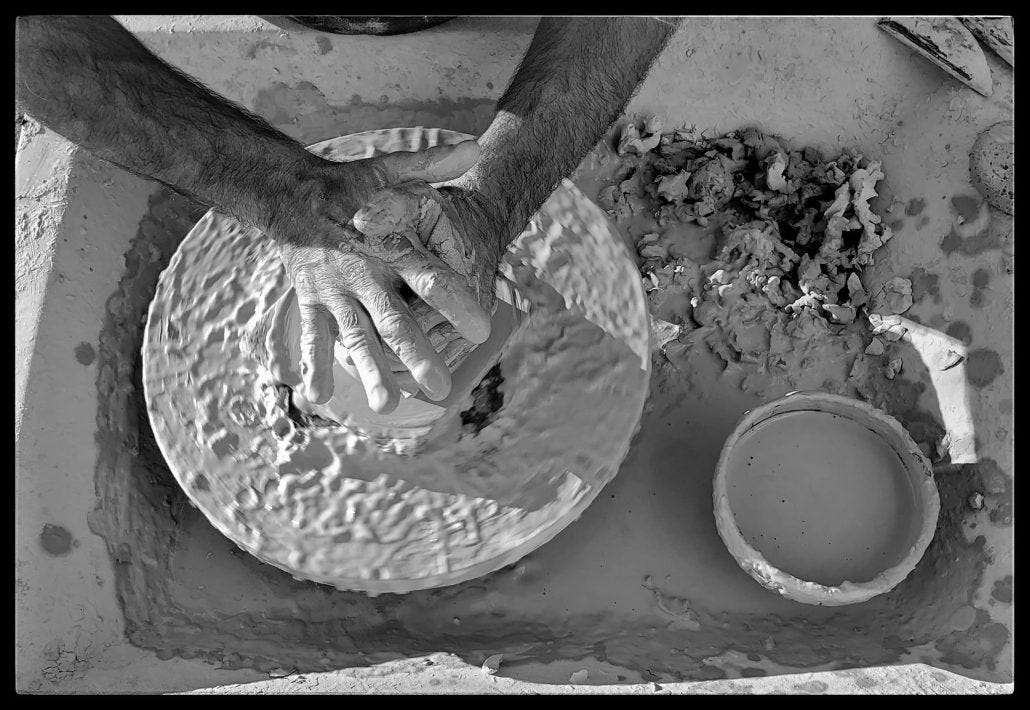
If I were living yesterday a second time: I would have been easier on myself at the wheel in the beginning and saved the self-criticism for later when I actually knew enough to make it useful. Bad early pots are not a sign you can’t do this. They are proof that you started.
Things I am grateful for: My first terrible pots and everything they taught me. The forgiving nature of clay that lets you wedge it back up and try again.
If I get to live to be 86, I might only have: 12,669 days left. A few of the early ones went toward lumpy walls and collapsed cylinders that turned out to be the best education I ever got.
Originally published at Creek Road Pottery
Connect with Creek Road Pottery LLC:
Website | Shop | The Pin Tool Podcast | Instagram | Facebook | Bluesky